

Quick Facts
- Hot air balloons have a rich history dating back more than 240 years and were the first form of aircraft to carry humans into the sky.
- The highest-flying hot air balloon reached nearly 69,000 feet; however, most commercial passenger hot air balloon rides remain between 1,000 and 9,000 feet above ground.
- Hot air balloon pilots use vertical movement to navigate horizontally, rising and descending to catch varying wind currents at different altitudes.
- The Albuquerque International Balloon Fiesta® is the largest hot air balloon festival in the world. In 2025, it showcased 537 hot air balloons and attracted roughly 851,994 visitors.
Uncovering the 10 Most Interesting Facts About Hot Air Ballooning
Despite relying on rather simple scientific principles such as convection, hot air balloons have consistently fascinated people for about two and a half centuries, mainly because of the dazzling views they offer to both the passengers inside and the onlookers below. However, there is more to hot air balloons than photo opportunities; they have a fascinating history chock-full of record-breaking achievements and remarkable innovations.
There are so many cool facts about hot air balloons, regarding their role in human aviation, how they function, the uniqueness of each flight, and how large the fanbase is. So, if you are preparing for your first balloon ride, looking for fun trivia, or simply curious about how a hot air balloon works, this is the guide for you.
Below, you’ll discover 10 fun facts about hot air balloons that highlight their history, science, capabilities, and enduring appeal—some may surprise you, while others may inspire you to add a balloon ride to your own bucket list.
Fact #1: Ballooning Has Been Around for More Than 240 Years
When people think about aviation, airplanes and helicopters often come to mind first. However, one of the most interesting facts about hot air balloons is that they predate virtually every other form of human flight.
Hot Air Balloons Were the First Successful Form of Human Aviation
The history of hot air ballooning dates all the way back to the 18th century, with the first successful flight taking place in 1783 in France. Joseph-Michel and Jacques-Étienne Montgolfier are the French aviation pioneers credited with demonstrating that heated air could lift a large fabric envelope and carry passengers into the sky. This achievement marked the beginning of human aviation and forever changed how people viewed transportation and exploration.
More than two centuries after the first successful hot air balloon flight, the fundamental principle of lighter-than-air (LTA) travel remains the same. These vehicles still rely on heated air to generate lift, but the main difference is that modern balloons feature more advanced materials, sophisticated burner technology, and improved safety systems.
Fact #2: The First Passengers Weren’t Human
One of the most famous fun facts about hot air balloons involves the very first passengers. Before risking human lives, early balloon pioneers wanted to understand how flight might affect living creatures. To accomplish this, the Montgolfier brothers launched a flight with a sheep, a duck, and a rooster aboard, roughly two months before humans were invited into the sky.
These particular animals were each chosen for a specific reason:
- The sheep, which was named “Montauciel,” a French name that roughly translates to “climb-to-the-sky,” was chosen because its internal biology and physiology were believed to closely resemble a human’s at that time.
- The duck was the scientific control. Since ducks naturally fly at high altitudes, the selected waterfowl was expected to survive the trip easily and prove that altitude sickness wouldn’t be an issue.
- The rooster served as a comparative test. Roosters are birds that fly very little and do not reach high altitudes, making them ideal subjects to test the effects of air travel on non-high-flying creatures.
The Animal-Occupied Flight Was Successful
The three aforementioned animals were launched in a tethered hot air balloon before a crowd that included members of French royalty. The flight was successful, and all three animal passengers returned safely to the ground. The results gave inventors confidence that humans could survive a balloon journey, paving the way for the first manned flight later that same year.
While aviation testing has evolved considerably since then, these animal passengers remain an unforgettable part of ballooning history.
Fact #3: Hot Air Balloons Require Less Heat In the Winter
The science behind hot air balloon flight is rather straightforward: When a pilot heats the air inside a hot air balloon’s envelope using propane burners, the warmer air becomes less dense than the surrounding atmosphere, causing the hot air balloon to rise through convection.
Since lift is driven by the temperature difference between the air inside the envelope and the ambient air, pilots must heat the air inside the balloon to a much higher temperature to achieve the same lift on a hot summer day as on a cool winter morning.
The Air in the Envelope Must Be At Least 100°F Hotter Than the Ambient Air
If it’s a brisk 70°F on a summer morning, a hot air balloon’s internal air will likely need to hover around 190°F to 215°F during cruising. However, if it is wintertime and the outside temperature is just above freezing, at around 40°F, the air inside the hot air balloon envelope may only need to be around 160°F to 185°F for flight.

Fact #4: Pilots Don’t Steer the Balloon, Traditionally Speaking
One of the most surprising hot air balloon facts is that pilots steer a hot air balloon way differently than someone would steer an airplane. Three things to remember are:
- Hot air balloons do not have steering wheels, ailerons, or rudders
- Hot air balloons travel with the wind rather than through it
- Different layers of the atmosphere often move in slightly different directions and at different speeds
Pilots Navigate By Changing Altitude
By ascending or descending, pilots can locate wind currents that help guide the balloon toward a preferred route. As a result, every flight is unique—even when launching from the exact same location on consecutive days, the balloon may follow a completely different path because wind patterns constantly change.
Flights are still well-controlled. Commercial hot air balloon pilots spend years mastering the ability to read atmospheric conditions and identify useful wind layers to ensure the safety of hot air balloons.
Fact #5: Hot Air Balloons Can Reach Impressive Heights
Most commercial balloon rides reach altitudes of about 1,000 to 9,000 feet above the ground, though where each flight falls on this range depends on how conducive the weather is for hot air ballooning, along with terrain and local regulations.
Despite this relatively low cruising altitude for passenger rides, hot air balloons can reach much greater heights, but additional flight planning becomes necessary. Some things that happen at higher elevations are:
- Temperatures become colder
- Air becomes thinner
- Visibility can increase dramatically
The Highest Hot Air Balloon Flight Exceeded an Altitude of 68,000 Feet
One of the most impressive records in ballooning history was set by Vijaypat Singhania in Mumbai, India, on 26 November 2005. According to Guinness World Records, Singhania reached an altitude of approximately 69,000 feet in a specially designed hot air balloon.
This means the maximum altitude of hot air balloons exceeds the cruising altitude of many commercial aircraft. For example, the most popular variant of the Boeing 747, the 747-400, has a maximum operating altitude of 45,100 feet, about 24,000 feet lower than Singhania’s record.
While recreational hot air balloon flights remain much lower, records like this demonstrate the remarkable capabilities of LTA technology.
Fact #6: No Two Balloon Flights Are Exactly the Same
Unlike a commercial airline route that follows a fixed flight plan, every balloon journey is shaped by nature. Wind speed, wind direction, temperature, and atmospheric conditions all influence the route a balloon follows. Some things these factors impact are:
- Launch locations
- Daily flight paths
- Landing area
- Views from the air
Passengers who take multiple balloon rides often discover that each experience feels entirely different—one day might feature dramatic mountain views, another might highlight wildlife, rivers, forests, or desert landscapes. This unpredictability is one of the reasons hot air ballooning continues to attract repeat passengers year after year.
Fact #7: Balloon Festivals Draw Massive Crowds
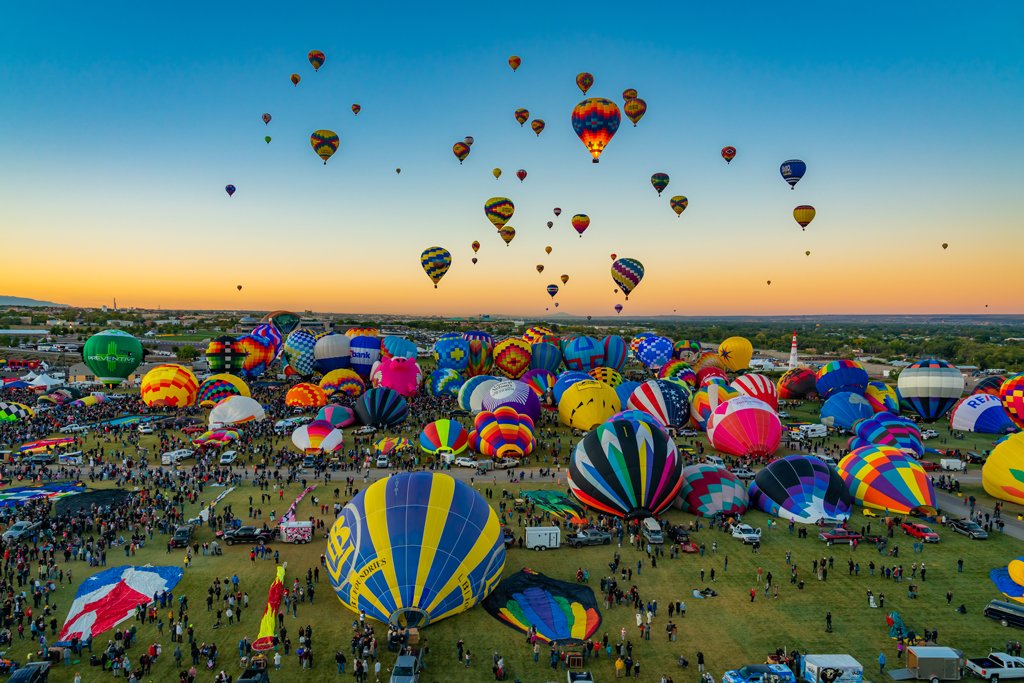
Among the coolest facts about hot air balloons is the sheer scale of some of the hot air balloon festivals. Around the world, balloon events attract hundreds of pilots and thousands of spectators.
One of the most famous examples is the Albuquerque International Balloon Fiesta®. Held each year in New Mexico, the event regularly features hundreds of balloons launching over the course of the festival. In 2025, it showcased 537 hot air balloons, drawing an in-person attendance of approximately 851,994 and 1,020,379 views on Balloon Fiesta Live.
Mass Ascensions Are the Main Draw
Seeing dozens or even hundreds of colorful balloons rise into the sky simultaneously offers an unforgettable visual spectacle that is unlike any other aviation event, encouraging people to travel from near and far.
Nevertheless, some other attractions you may find at a hot air balloon festival are:
- Hot air balloon glows
- Tethered rides
- Music and other live entertainment
- Food vendors
- Kids’ zones complete with bounce houses and games
Fact #8: Hot Air Balloons Can Travel Across Countries
Hot air ballooning isn’t limited to short sightseeing flights—throughout history, pilots have completed remarkable long-distance journeys using atmospheric wind currents. In fact, several record-setting flights have crossed countries, oceans, and even continents.
The First Non-Stop Round-the-World Balloon Flight Was in 1999
Bertrand Piccard and Brian Jones completed the first nonstop balloon flight around the world right before the year 2000. Their journey covered more than 28,000 miles and demonstrated the incredible potential of long-distance hot air ballooning.
Expeditions like these require extensive planning, specialized equipment, weather forecasting, and coordination, but they showcase just how far balloons can travel when pilots successfully harness global wind patterns.
Fact #9: Most Hot Air Balloons Are Surprisingly Portable
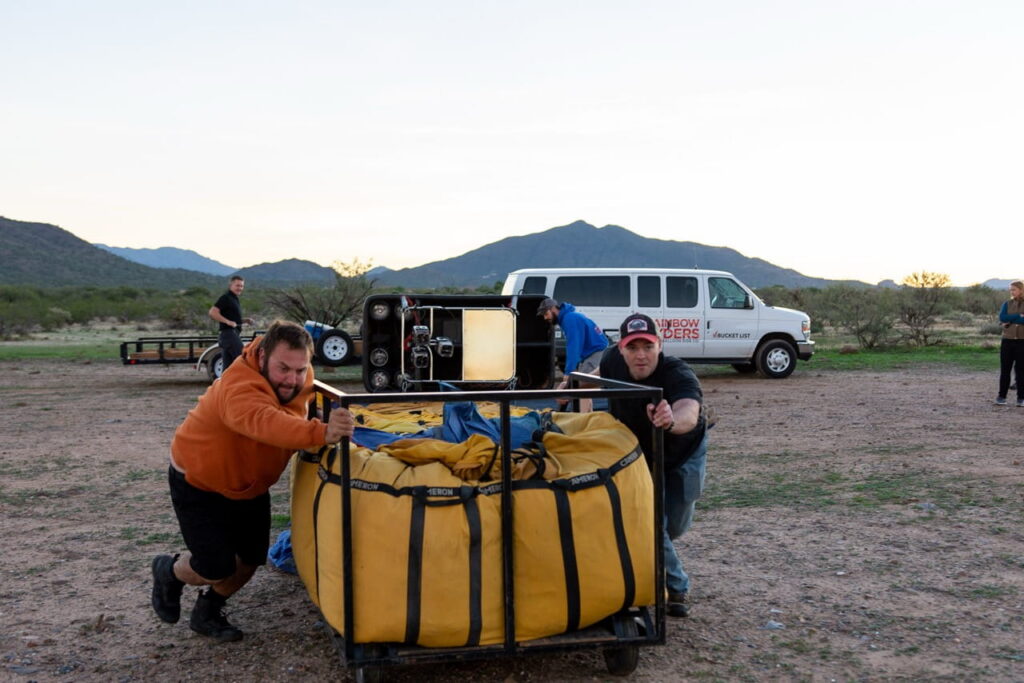
When fully inflated, a hot air balloon appears enormous, so many passengers are shocked to learn how compact the aircraft becomes once packed away.
Some things hot air balloon pilots and their ground crew do to promote portability after a hot air balloon landing are:
- Deflate the envelope
- Fold the fabric
- Secure the equipment
- Load components into a trailer
As a result, a balloon large enough to carry numerous passengers can often fit in a transport trailer that can be pulled by a standard vehicle, such as a van. This portability allows operators to move balloons between launch locations, festivals, and special events throughout the year.

Fact #10: Hot Air Balloons Are Incredibly Peaceful
Many first-time passengers expect a hot air balloon ride to feel similar to being on an airplane, but in reality, it feels very different. One of the most interesting facts about hot air balloons is how quiet they are.
There are occasional bursts from the burner system that can reach output levels of 85 to 105 decibels (dB), which is a little bit louder than a hair dryer but not as loud as a typical rock concert. However, these bursts don’t last long, usually 3 to 10 seconds at a time, to maintain altitude. Other than that, there is very little noise during a hot air balloon flight.
Many People Refer to Hot Air Balloon Rides As “Dream-Like”
Because the balloon moves with the surrounding air mass, passengers often report things like:
- Minimal turbulence
- Little sensation of speed
- Gentle movement
- Remarkable tranquility
Instead of hearing engines or feeling constant vibration, passengers can focus on the scenery, the sounds of nature below, and the unique sensation of floating through the sky.
Bonus Hot Air Ballooning Trivia
If you’re looking for even more cool facts about hot air balloons, here are a few bonus pieces of ballooning trivia:
- Balloons often fly at sunrise – Sunrise hot air balloon flights are popular amongst commercial ride operators because early morning conditions typically provide the calmest and most stable air.
- Wicker remains the preferred basket material – This material is lightweight, durable, and absorbs landing impacts effectively, which is everything a hot air balloon basket needs to be.
- Modern burners use propane fuel – Propane delivers high heat output while remaining easy to store and transport.
- Commercial hot air balloon pilots must be licensed – Pilots receive specialized training and certification before carrying passengers.
- Balloon envelopes are made from advanced fabrics – Modern nylon materials are lightweight, strong, and heat-resistant.
These details help illustrate how ballooning combines centuries-old principles with modern engineering and safety practices.
A Chief Pilot at Rainbow Ryders is a World Record Holder
The hot air balloon fact that delights Rainbow Ryders the most is the fact that our chief pilot in Albuquerque, Troy Bradley, is one of the most accomplished balloonists in the world.
Some of his most noteworthy awards and achievements include:
- He has earned 64 Federation Aeronautique Internationale (FAI) world record diplomas
- He is the only three-time recipient of the FAI’s Montgolfier Diploma, the highest international award in ballooning.
- He completed the first U.S. to Africa hot air balloon flight in 1992 during the only balloon race ever held across an ocean.
- He became the first person, and one of only two people, to hold world records in gas (AA), hot air (AX), and hybrid/Rozier (AM) balloon categories.
- He won the prestigious America’s Challenge gas balloon race in 1998 and later held the race duration record at 68 hours, 46 minutes.
- In 2015, Troy Bradley and Leonid Tiukhtyaev flew the Two Eagles balloon from Japan to Mexico, traveling more than 6,600 miles and spending over 160 hours aloft, setting world records for gas balloon distance and duration.
If you are interested, you can read this more comprehensive list of Troy’s records to see why the rest of our amazing pilots look up to him as a pioneer in the ballooning industry.
Experience Ballooning for Yourself
The world of hot air ballooning is filled with fascinating history, remarkable achievements, and surprising science. From carrying the first humans into the sky to completing record-breaking journeys across continents, hot air balloons have earned their place as one of aviation’s most enduring and captivating inventions.
Even though reading about these fun facts about hot air balloons can deepen your appreciation for the aircraft, nothing compares to experiencing ballooning firsthand. The peaceful atmosphere and panoramic views while floating on a Rainbow Ryders hot air balloon can create memories that last a lifetime.
If you’re ready to put some of these interesting facts about hot air balloons to the test, including the fact that they are incredibly peaceful, book a flight in one of the four corners of the Southwestern United States.