

Executive Summary
- The air inside a hot air balloon’s colorful, billowy envelope is less dense than the cooler air outside, causing it to rise due to buoyancy.
- Hot air balloon pilots use burner systems to produce controlled, propane-powered flames that rarefy the air inside the envelope, spreading its molecules to produce lift.
- Since buoyancy depends on environmental conditions, the pilot closely monitors outdoor temperature to maintain stable, controlled flight.
- Passengers may feel more confident about flying if they learn about the science behind hot air ballooning. Doing so can also make the experience more fascinating.
The Science Behind the Lift
At first glance, magic may seem to be the reason why hot air balloons rise. These lighter-than-air (LTA) vehicles have a fantastical appearance and fairy-like weightlessness as they drift above landscapes. However, even though they don’t have a traditional engine or wings, hot air balloons are carefully engineered and deeply rooted in physics.
If you’ve ever wondered why hot air balloons float, the answer lies in a basic scientific principle: hot air rises. When the LTA vehicle’s burner heats the air inside the fabric envelope, the gas’s molecules move faster and spread farther apart. As a result, the air becomes less dense than the surrounding cooler air, generating lift due to buoyancy.
Thoroughly understanding how pilots leverage convection in a hot air balloon can make you feel more confident and enthralled during your recreational flight. The guide below explains the physics of LTA travel, detailing how the components of a hot air balloon work together to make it fly.
How Heat Creates Buoyancy
To fully understand why hot air balloons rise, you must start by learning about convection and buoyancy. The two sections below serve as an introduction to these scientific principles, helping you understand how they apply to hot air balloons.
What is Convection?
Convection is the process by which heat causes fluids, including air, to move. It is the primary reason heat rises, and cooler, denser fluids sink.
Three important things that happen to air when it is heated are:
- Its molecules gain energy, forcing them to move faster
- The molecules spread out, increasing the air’s volume
- The air becomes less dense compared to the cooler surrounding air
Flames are used to incite convection in a hot air balloon, causing the three steps above to occur inside the vehicle’s envelope, which is the large fabric portion that makes hot air balloon photos so breathtaking.
Buoyancy in Action
Buoyancy is the upward force a fluid, like air, exerts on an immersed object. When a pilot heats the air inside their hot air balloon’s envelope, making it less dense, the balloon becomes more buoyant, meaning the surrounding cooler air pushes it upward.
This is the same principle that allows a helium balloon to float, since helium is naturally less dense than the combination of gases found in our atmosphere. However, hot air balloons don’t use helium; they rely solely on temperature differences to create the density disparity needed to fly. In general, the greater the temperature difference, the stronger the lift.
The beauty of this system is that it’s easily controllable. To rise, a hot air balloon pilot heats the air inside the envelope. When it is time to descend, they either allow the air to cool passively or actively release hot air through the balloon’s venting system. This continuous adjustment of temperature gives pilots precise control over altitude, all based on the simple physics of convection.
The Role of the Burner System
Modern hot air balloon technology uses propane to heat the air inside the envelope. When activated, the hot air balloon’s burner produces a powerful, controlled flame that rapidly raises the air temperature, rarefying it, which means making it less dense.
Using a long burst from the burner system allows pilots to generate lift quickly during takeoff. Then, they can dial back burner usage to maintain a steady altitude during flight, adjusting height based on environmental conditions. Trained pilots exhibit a high level of precision and control during hot air balloon flight, which you can learn more about below.
How Are Burners Used During a Hot Air Balloon Flight?
Pilots do not use burners like light switches, which are simply turned on and off. Instead, they carefully regulate the intensity and duration of each flame burst according to the stage of their flight. The table below shows how burner usage may vary throughout your hot air ballooning journey.
| Stage of the Flight | What Burner Use May Look Like |
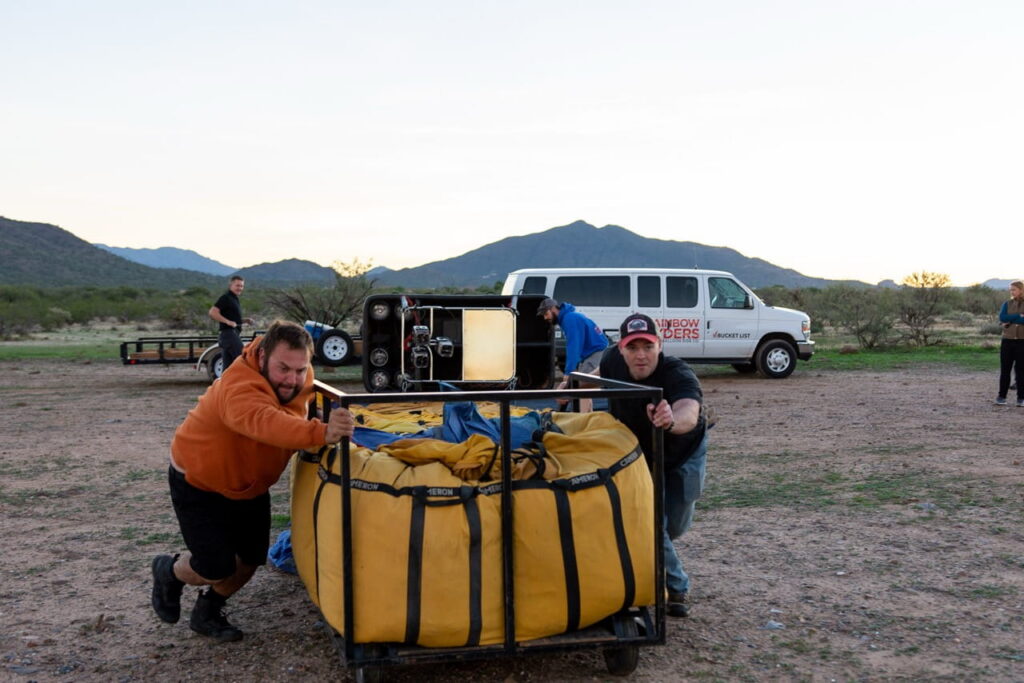
| Pre-flight inflation | Before the flight, the burner is used for about 2 to 5 minutes to inflate the envelope; though, the entire setup, including pulling out fabric, cold inflation, and then hot inflation, takes about 15 to 30 minutes. |
| Takeoff and initial ascent | When the ride is just starting, the hot air balloon must climb steadily. To accomplish this, the pilot will likely use long bursts of flame from their burner. |
| Mid-flight altitude maintenance | When they reach the desired altitude, the hot air balloon pilot can use short bursts to maintain their position, subtly adjusting altitude to catch specific wind currents. |
| Final descent | When it is time to prepare for landing, pilots will use their burner system much less, naturally allowing the air to cool or venting it to achieve a quicker descent. |
Commercial hot air balloon pilots are thoroughly trained in burner operation and exhibit a high level of control, which is essential for smooth, predictable flight.
Built-In Safety
Modern balloon systems are designed with safety in mind. Some burner-related safety precautions that have become commonplace in the hot air ballooning industry are:
- Having multiple burners on each basket for redundancy
- Keeping additional fuel systems as backup
- Ensuring ignition systems are reliable through frequent testing
The precautions above ensure that, even in the unlikely event of a malfunction, the pilot can maintain control of the hot air balloon using the backup equipment. As a testament to burners’ safety, Rainbow Ryders has been flying since 1983 and has never had a balloon malfunction resulting in a fatality or major injury.
Envelope Design and Airflow
Even though the burner produces flames, it wouldn’t generate lift without the envelope capturing and containing the heat. The envelope may just look like a fun, simplistic ball of fabric from a distance, but it is a carefully designed structure built to distribute air evenly, allowing it to retain heat and its shape under varying conditions.
Even Heat Distribution
The traditional hot air balloon shape, which is often described as teardrop-like, helps ensure that warm air circulates efficiently. This classic-looking design ensures consistent buoyancy by allowing heated air from the burner to rise directly to the crown of the hot air balloon and then sink as it cools near the envelope’s walls.
Keep in mind that the envelope’s size and volume directly determine how much air it can hold, which affects how high the hot air balloon can fly.
What Are Hot Air Balloon Envelopes Made Of?
Modern envelopes are typically made from durable, heat-resistant materials such as nylon or polyester. Most Rainbow Ryders balloons use Hyperlast™ balloon fabric, a specialized silicone-coated nylon material with superior strength and tear resistance. Some other beneficial features of this type of material are:
- Lightweight yet strong construction
- Resistance to high temperatures
- Designed to minimize heat loss
- Enhanced UV protection
Traditional hot air balloon envelopes are constructed from multiple panels stitched together to form the aforementioned teardrop shape, which promotes stable airflow.
Controlling Flight Through Temperature Differences
Hot air balloons don’t have steering wheels or engines in the traditional sense. Pilots steer hot air balloons in a unique way, relying on temperature control and environmental awareness to guide the flight.
As discussed earlier, adding heat increases lift and causes the balloon to rise, and allowing the air to cool reduces lift and causes descent. This system is remarkably responsive—even small temperature changes can lead to noticeable shifts in altitude.
Working with the Environment
While hot air ballooning, wind speed and direction often vary at different altitudes. Pilots must take advantage of natural wind patterns to move horizontally. By strategically ascending or descending, pilots can find favorable wind currents that shift their course, allowing them to navigate more effectively.
The interplay between convection in a hot air balloon and atmospheric conditions creates a dynamic, ever-changing flight experience.
Why Understanding Convection Matters
Although passengers can relax while hot air balloon operators focus on the science of LTA travel, understanding why hot air balloons float can add a new layer of appreciation. It builds confidence, enhances the experience, and supports hot air balloon safety, as explained in the table below.
| What Understanding Convection Helps With | What to Remember | Potential Benefit to Passengers |
| Building Confidence | LTA travel relies on predictable physics, not chance | Reduces fear and increases trust in the experience, allowing passengers to feel more comfortable before takeoff |
| Enhancing the Experience | Heat, air, and density are what make LTA travel so engaging | Creates a greater awareness of altitude and movement, helping riders notice burner use and subtle elevation changes |
| Supporting Safe Operations | Pilots use convection principles to manage flight safely | Reassures passengers of professional control, giving them faith that the flight will be smooth and well-controlled |
Rising with Precision
The reason hot air balloons work so well is their balanced system. The burner heats the air within the envelope, and the surrounding air provides resistance, creating lift through a carefully managed density difference. Now that you understand the basics of why hot air balloons rise, the next step is to see them in person.
If you’re ready to experience the power of convection in a hot air balloon firsthand, there’s no better way than taking a ride operated by Rainbow Ryders. There are so many reasons to choose Rainbow Ryders for hot air ballooning, from our impressive safety record to our pilots’ fascinating knowledge and willingness to share fun facts about the craft of LTA flight and why hot air balloons float.
Book your flight in the Southwestern United States today! Rainbow Ryders operates in Albuquerque, Colorado Springs, Phoenix, and Park City.
Additionally, if you have any questions or concerns, contact our team. We would love to further explain how we have used science, skill, and a little heat to lift over 750,000 passengers into the sky over the last 40+ years.