

Key Takeaways
- Hot air balloon landscapes change throughout the flight; the familiar surroundings of the launch site will fade away as you encounter new terrain along the flight path.
- The higher you fly, the more hazy the ground below may get because you will be looking through a much longer, angled column of air filled with microscopic particles that scatter and reflect sunlight.
- Wind conditions impact the balloon’s direction of travel and determine how a hot air balloon landscape unfolds, making each flight different.
- Temperature and lighting can change during a flight, so bringing sunglasses and dressing in layers is recommended to promote consistent comfort throughout the entire journey.
The Way Scenery Evolves During a Hot Air Balloon Ride
The view from a hot air balloon is constantly changing from the moment the aircraft lifts off to the final approach for landing. So, even if a passenger is taking pictures every few minutes, each hot air balloon landscape photo will be slightly different from the last.
To fully experience the evolution of hot air balloon landscapes, passengers are encouraged to take note of the scenery while at the launch site. It can feel like magic when the features you noticed at ground level start to recede as the balloon rises and drifts with the wind. One of the most special parts about hot air ballooning is when surrounding terrain becomes part of a broader picture, and new areas come into view as the journey unfolds.
In addition to the views, lighting and temperature may also change throughout the experience. The guide below explains this progression to help you know what to expect at each stage of your flight, so you can adequately prepare for your first hot air balloon ride.
Knowing What to Expect from the Launch Site
To promote hot air balloon safety, Rainbow Ryders, the largest hot air balloon operator in the United States, always chooses launch sites that are an appropriate distance away from potential obstacles, such as:
- Power lines and electrical infrastructure
- Buildings and other structures
- Trees and tall vegetation
- Roads and vehicle traffic
- Airports and restricted airspace
Keep in mind that surface conditions can vary at the launch site depending on recent weather and which of our four service areas the flight is taking place in: Albuquerque, Colorado Springs, Phoenix, or Park City. However, closed-toed shoes are vital regardless, as they can help you navigate dusty, muddy, or rocky spots, and they offer protection when other passengers shift around in the basket midflight.
The View From the Basket Before Takeoff
Because it will still be grounded during boarding, when you first get into the hot air balloon basket, you will remain at roughly eye level. Therefore, you will still only be able to see nearby terrain features and larger landmarks, such as mountains or forests with tall trees.
As the balloon crew prepares for flight, the experience will start to change. The envelope will pull the basket upward, and you’ll leave the ground. The scenery itself may remain familiar at first, but you’ll be looking at it from a different perspective.
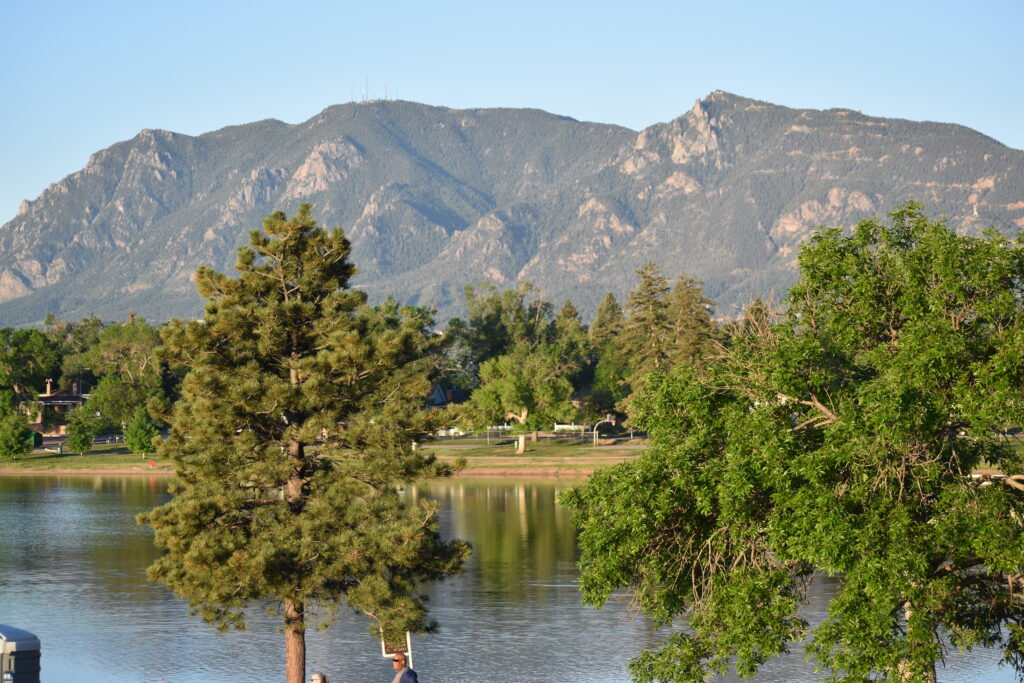
This is a near-ground-level view from a Rainbow Ryders hot air balloon in Colorado Springs, showing Cheyenne Mountain and Cheyenne Mountain Lake.
Fun fact: There is a massive Cold War-era nuclear-proof military bunker roughly 2,000 feet below Cheyenne Mountain’s solid granite exterior.
The First Few Minutes of Flight
The initial part of the ascent may only offer subtle changes. Trees, large rocks, and other nearby features will still be recognizable, but their position relative to the basket and the horizon will begin to shift. As the flight continues, the launch site will gradually separate from the balloon, and the surroundings will look less familiar.
There is no single moment when the landscape becomes entirely different. Instead of suddenly arriving at a high vantage point, as you do when using elevators and fast-moving aircraft, the view develops continuously throughout the duration of the hot air balloon ride. You will also move up and down in altitude for the 45 to 60 minutes you are airborne, keeping things consistently interesting.
Watching the Earth Move Beneath You
The further a hot air balloon ascends, the further it moves horizontally as well, because it floats with the wind. So one of the things you can expect from a hot air balloon ride is for new areas to enter your field of view as the balloon drifts away from the starting point. Passengers are not simply looking at a stationary scene from above; they are constantly traveling through the environment.
The precise route varies with the weather and wind conditions, so passengers should not expect to follow a predetermined sightseeing path. That uncertainty is part of what makes each flight one-of-a-kind.
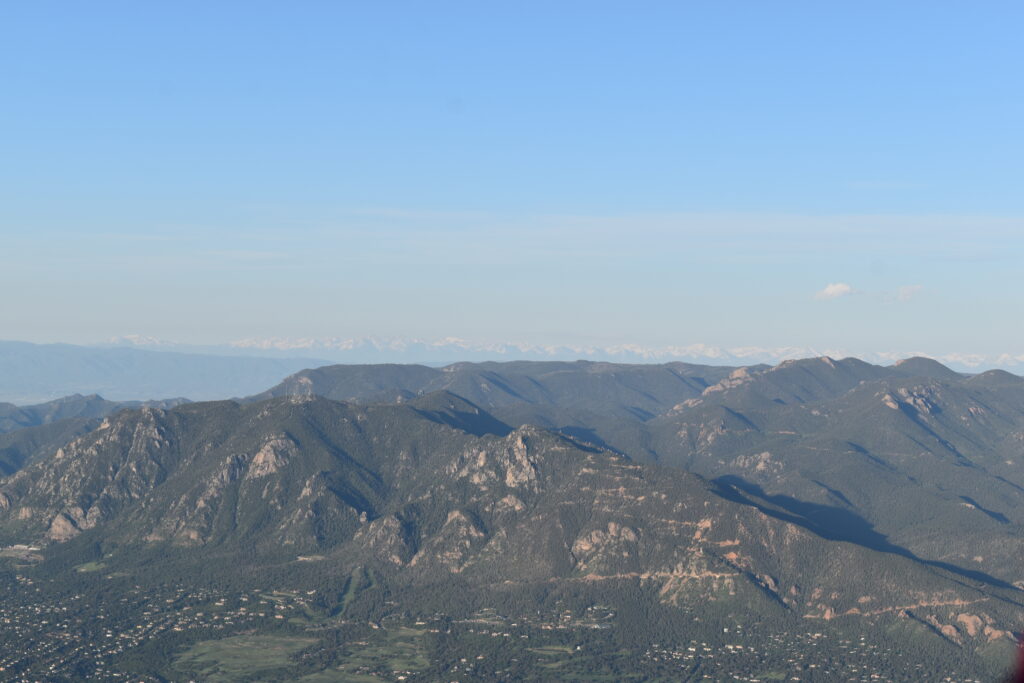
This is another view of Cheyenne Mountain taken during the middle of a Rainbow Ryders hot air balloon ride in Colorado Springs, showing how perspectives can change. Note that Cheyenne Mountain Lake is no longer visible from this angle.
How Light and Temperature Change Along the Route
During a hot air balloon ride, the landscape can look different as sunlight shifts across the terrain. For example, when a sunrise flight launches, a ridge facing the rising sun may already be illuminated, but a nearby valley remains in shadow. As the flight progresses, sunlight reaches more of the landscape, changing the contrast between sunlit slopes, shaded areas, and distant features—by the time you approach landing, the balance of light may look noticeably different from what you saw at takeoff.
How much the landscape changes depends on several factors:
- The season and time of sunrise
- Cloud cover and weather conditions
- The direction of the sunlight relative to the terrain
- The duration and route of the flight
Temperature can change alongside lighting. Ground temperatures are naturally cooler before sunrise, and the surrounding air is theorized to get about 3.6°F colder every time you go up 1,000 feet in elevation. Still, how cold a hot air balloon gets depends on wind, sunlight, starting conditions, and the altitude your balloon reaches.
The hot air balloon burner can radiate warmth toward the basket when it is periodically fired up, but passengers remain in the open air. It is best to dress for the expected conditions rather than rely on the burner to keep you warm.
How to Prepare for Changing Conditions
A few simple preparations can help passengers remain comfortable at all stages of the flight. Some examples of things Rainbow Ryders recommends bringing are:
- Sunglasses – Especially on sunrise flights, lighting can change dramatically, making it important to come prepared
- Layers – A light jacket or removable outer layer can help you adapt to changing temperatures.
- Closed-toe shoes – Appropriate footwear is useful while in close quarters with others and on uneven launch and landing terrain.
- A hat – A baseball cap or sun hat can provide extra shade during the flight.
- Sunscreen – Apply sunscreen before your ride to help protect exposed skin from UV rays, even on cooler mornings.
These items can make it easier to stay comfortable and pay attention to the changing environment throughout the flight.
The Ground May Look Hazy From Higher Altitudes
As a hot air balloon rises, the landscape below may appear hazier or less distinct for the passengers on board. This is because from higher altitudes, passengers are looking through a longer, angled column of air that contains tiny particles from things like:
- Dust
- Pollen
- Smoke
- Soot
- Soil and minerals
- Plants and other natural sources
These particles have the potential to scatter sunlight, which can reduce contrast and make distant features look softer or less defined. However, the effect varies with air quality, humidity, and weather conditions—on clear days, the landscape may remain sharply visible, while hazier conditions can give distant mountains, buildings, and other landmarks a softer appearance.
How the Ground Looks as You Approach the Landing Site
One of the things you can expect during landing is for the details of the ground to become more prominent again as the balloon gets lower. Even if you have only traveled a handful of miles away, you may notice that the location looks very different from the launch site; for instance, you may have taken off on a rocky plain but land in a grassy field.
Your pilot will strategically choose the landing site based on wind, terrain, and other safety considerations. The ground crew will keep in contact and follow the balloon’s progress so they can ultimately help with packing up and transporting all the passengers back to whichever one of our meetup locations they started at.
This final stage brings the experience full circle. At takeoff, you watched the launch site gradually recede as the balloon rose. Near landing, you watch the ground become the focus again as the balloon descends. Once the balloon has landed and the crew has secured it, passengers can step out and return to ground level with a different sense of the terrain they have just traveled across.
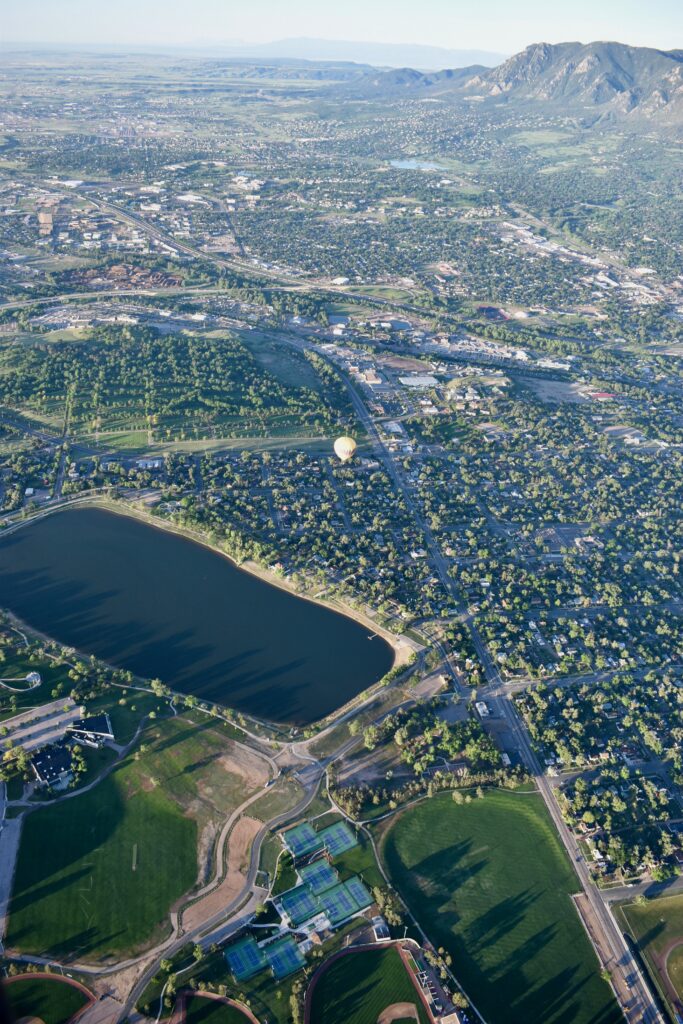
A view of the ground from a Colorado Springs Rainbow Ryders ride, with a hazy view of Cheyenne Mountain fading away in the distance.
Experience the Journey for Yourself
Hot air balloon landscapes are constantly changing. The launch site gradually recedes, new surroundings come into view, wind conditions shape the route, and the approach to landing provides a final shift in perspective.
Because these elements vary from one flight to another, no two journeys unfold in the same way. The experience is about following that progression and seeing how the relationship between the balloon and the ground changes along the way.
Rainbow Ryders offers breathtaking hot air balloon rides in Albuquerque, Phoenix, Colorado Springs, and Park City. Whether you’re planning a special occasion or simply looking for a new way to experience the outdoors, you’ll be sure to remember the bucket-list-worthy views that happen during our flights.
Book your flight today to discover how the Southwestern landscapes look from above.